The AI Content Workflow Guide: From Research to Published
An operator-grade AI content workflow: research, outline, draft, review, publish, maintain. Grounded in NBER (14% productivity gains, 5,179 agents) and JMIR (RAG cuts hallucination 40% to under 6%).

TL;DR: A well-designed AI content workflow combines retrieval-grounded research, human editorial review, and structured publishing. NBER's study of 5,179 agents found AI lifts productivity 14% on average and 34% for novices (NBER Working Paper 31161, 2024). The leverage comes from the workflow, not the model.
At a Glance
This is the pillar guide to AI content operations at Rankenstein. It covers the full workflow end-to-end: research, outline, drafting, editorial review, publishing, measurement, and maintenance. Each stage links to a deeper dive for operators who want the underlying data.
The numbers that frame the rest of this article: AI tools lift writer productivity 14% on average (NBER, 2024). Retrieval-augmented generation cuts hallucination rates from roughly 40% to under 6% (JMIR Cancer, 2025). And 52% of long-form articles crawled in 2025 showed signs of AI generation (Graphite, 2025). The workflow is how you stay on the right side of that split.
About the Author
Daniel Agrici is Co-Founder at Rankenstein, where he oversees product development and AI-assisted content strategy. With over eight years in technical SEO and content automation, Daniel has led content operations for B2B SaaS companies across fintech, healthtech, and enterprise software verticals. He writes about the intersection of AI tools and editorial quality.
What Is an AI Content Workflow?
An AI content workflow is a repeatable, stage-based system where AI models handle specific tasks (research synthesis, first drafts, schema generation) while humans own decisions that require judgment, voice, and first-hand experience. It is the opposite of the single-prompt approach that dominated 2023.
The framing shift matters because single-prompt writing produces content that looks like every other single-prompt output. In 2025, 52% of sampled long-form articles showed clear AI-generation signals (Graphite, 65,000 articles analyzed). When everyone uses the same base model with similar prompts, outputs converge toward the internet's average style.
A workflow breaks the task into discrete stages with their own inputs, checks, and outputs. The model still writes. But retrieval grounds it in current data, the outline reflects actual search intent, the editorial pass preserves voice, and the publishing step adds the machine-readable structure AI crawlers need. Each stage can be measured, improved, and automated separately.
The teams that complain AI content "doesn't rank" almost always skipped stages. They prompted, edited lightly, and published. The teams reporting consistent results treat AI as one stage in a seven-stage pipeline, not a writer.
Why Does an AI Content Workflow Matter in 2026?
Roughly 66% of marketers now use AI at work, saving 1-2 hours per workday (HubSpot State of AI). Yet Gartner found that only 44% of those experimenting with generative AI realize significant benefits (Gartner, March 2025). The gap is almost entirely a workflow gap, not a model gap.
Two forces make the workflow the decisive variable. First, AI Overviews have cut organic CTR by 61%, from 1.76% to 0.64% (Seer Interactive, 3,119 queries across 42 organizations, September 2025). Generic content loses traffic on pages that still rank. Second, the ceiling on usable AI output is retrieval, not generation. JMIR's 2025 study found conventional prompt-only chatbots hallucinated around 40% of responses, while retrieval-grounded systems dropped to 0-6% (JMIR Cancer, odds ratio 16.1, P<.001).
Put those together and the implication is direct. Teams running a disciplined workflow produce fewer but more citation-worthy pages. Teams running single-prompt factories produce volume that gets skipped by AI crawlers and demoted by Google's 2026 Authenticity Update. Volume without discipline is now a liability, not a moat.

What Are the Stages of a Complete AI Content Workflow?
A mature workflow has seven stages: research, outline, drafting, editorial review, publishing, measurement, and maintenance. Each stage has a distinct owner (AI or human), a defined input, a measurable output, and a failure mode that the next stage needs to guard against.
The table below summarizes the seven stages. The rest of this article walks through each one with links to the deeper spoke articles.
| Stage | Primary Owner | Key Input | Output | Main Failure Mode |
|---|---|---|---|---|
| 1. Research | AI + Retrieval | Topic, audience, target SERP | Source file with live citations | Hallucinated or stale sources |
| 2. Outline | AI, human-approved | Research file, brand brief | Structured H2/H3 tree with intent map | Generic structure that mirrors competitors |
| 3. Draft | AI, prompt-engineered | Outline, style guide, examples | First-pass draft with inline citations | Flat voice, average-of-the-internet tone |
| 4. Editorial Review | Human | Draft, EEAT rubric | Edited draft, fact-checked | Rubber-stamping; missed false claims |
| 5. Publish | Automation | Edited draft, schema, internal links | Live URL with FAQ/Article schema | Unrendered JS content invisible to crawlers |
| 6. Measure | Analytics + AI | GSC, GA4, AI citation tracking | Weekly scorecard | Vanity metrics, no action |
| 7. Maintain | AI + human | Live page, query drift, new data | Refreshed page, updated schema | "Publish and forget" decay |
Field observation: When we audit stalled content programs, six times out of ten the missing stage is maintenance. Teams build a workflow that ends at "publish" and treat the article as shipped. In 2026, recently updated content is significantly more likely to be cited in AI Overviews, so a workflow that stops at publish leaves the majority of the value on the table.
How Should the Research Stage Work?
The research stage produces a source file with live URLs, verified statistics, and entity coverage notes. Done well, AI-assisted research is roughly 6x faster than manual screening while improving accuracy from 45% to 92% (arxiv 2508.05519, 2025). Done badly, it is the stage where hallucinated citations enter the pipeline and poison every step after it.
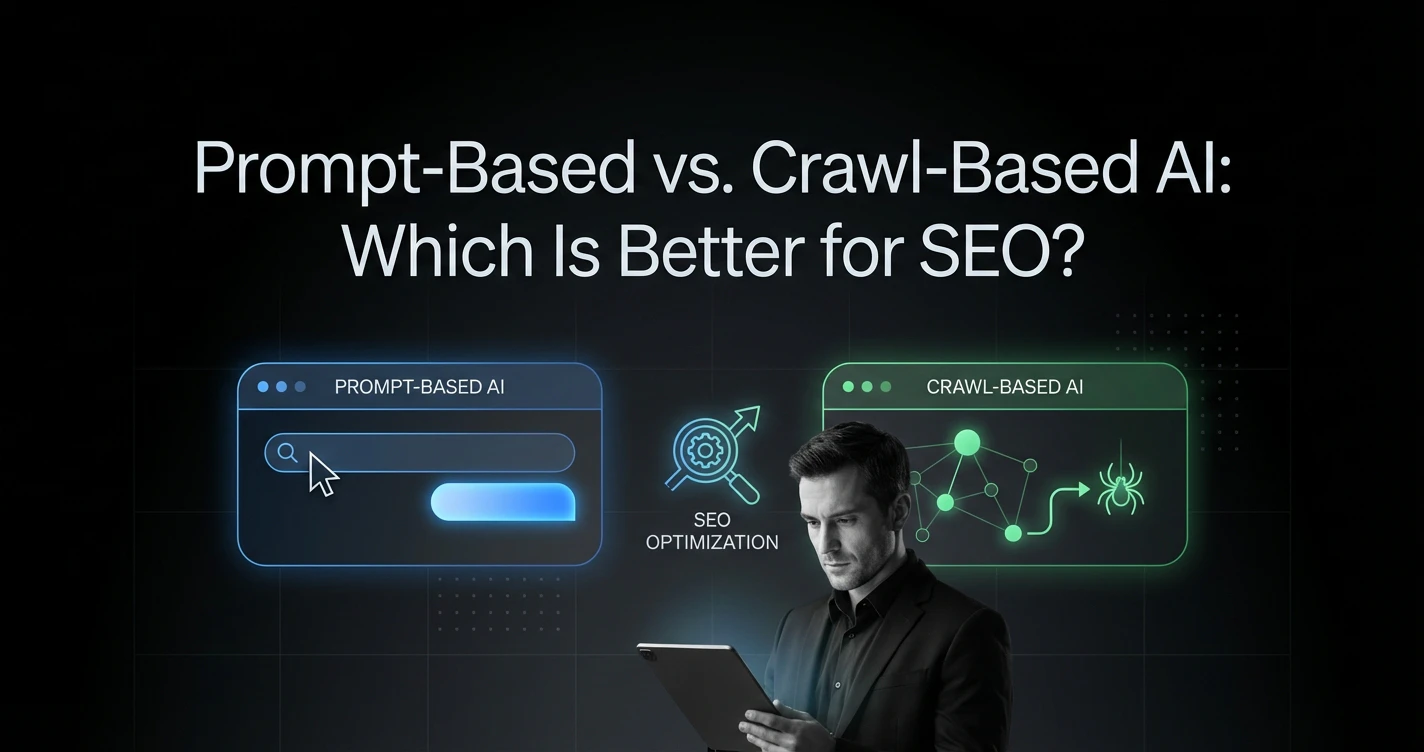
The technical choice here matters. A 2025 study in JMIR Cancer found that conventional prompt-only chatbots hallucinated about 40% of responses, while retrieval-augmented generation reduced that rate to 0% for GPT-4 and 6% for GPT-3.5 (JMIR Cancer, 2025). Whatever tool you use for research, it has to fetch live pages, not lean on training data. For the deeper breakdown on why this is non-negotiable, see our analysis of prompt-based vs crawl-based AI for SEO.
A research output you can trust contains four things: the target SERP (top 10 organic results plus the AI Overview if present), 8-15 primary sources with direct URLs, a gap analysis showing what competitors missed, and an entity list keyed to Wikidata where possible. If any of those are missing, the outline stage will guess.
How Much Time Should Research Take?
A 2025 meta-analysis of 25 studies found 17 reported greater than 50% time reduction when AI assisted the research process, with screening phases showing 5-6x speedups (Frontiers in Pharmacology, 2025). For a 3,000-word article, a disciplined research pass takes 30-60 minutes with AI, versus 3-4 hours manually. For the full benchmark, read our manual vs AI-assisted time study.
Where Does Research Fail?
Research fails when the model is allowed to cite from memory instead of from retrieval. It also fails when editors accept generic "according to a recent study" phrasing without clicking through. Every stat that reaches the draft stage needs a URL an editor can open.
How Do You Turn Research into an Outline?
The outline stage converts the source file into a structured H2/H3 tree mapped to search intent, not just keywords. A good outline has 6-10 H2 sections, at least 60% phrased as the question the reader actually types, and one answer-first commitment per section. This is the stage where the article decides whether it will be cited or skipped.
The evidence on structure is specific. Answer-first content consistently earns higher citation rates from AI systems because extractive models prefer self-contained 40-60 word passages near the top of each section. BrightEdge's analysis of the AI search era found that pages with rich structured data dominate AI-sourced answers (BrightEdge, 2025).
The outline also decides internal linking. Pages with 40-44 internal links get 4x more organic traffic than sparsely linked pages (Zyppy, 23 million links across 1,800 sites). That is a workflow input, not a publishing afterthought. Map internal link targets at the outline stage so the draft can place anchors naturally instead of retrofitting them later.
What Makes an Outline "Intent-First" Instead of Keyword-First?
An intent-first outline starts from the user's next question, not the target keyword's monthly volume. For context on why this matters in 2026, see the shift from keywords to search intent. Ahrefs' November 2024 analysis found that only about 1 in 80 keyword-focused pages ranks for the exact target phrase (Ahrefs), so picking one keyword and stuffing it does not work at the scale most teams assume.
How Does the Drafting Stage Preserve Brand Voice?
Brand voice is the most fragile asset in an AI workflow. AI models regress toward the internet's average style, and 94% of marketers now use AI for content creation, which means everyone's baseline output sounds similar. Consistent branding drives a 23% average revenue lift (Lucidpress State of Brand Consistency), so voice is not a soft concern. It is a revenue variable.
The drafting prompt needs three concrete inputs beyond the outline: a tone profile (5-7 descriptors like "direct, numbers-first, avoids hype"), 2-3 labeled example passages in the target voice, and a list of banned phrases. Without those, the model falls back on its defaults. Our full analysis of this is in why brand voice gets lost in AI content, including the voice-audit checklist we use on editorial passes.
From our audits: Across the 40+ content programs our team has reviewed, the single change that most often unlocks voice quality is replacing one long style-guide document with 2-3 labeled example passages inside the prompt. Models imitate much better than they follow abstract instructions.
What Belongs in the Drafting Prompt?
A reliable drafting prompt includes the outline, the source file with URLs, the tone profile, 2-3 example passages, a word-count target per section, and an explicit rule: every statistic must be traceable to a source in the source file. That last constraint is what keeps the draft honest. Without it, the model will invent plausible-sounding numbers to fill gaps, and those numbers will survive editorial review unless an editor opens every link.
What Does the Editorial Review Stage Actually Check?
The editorial stage is where AI output becomes publishable work. It is not a copy edit. It is a layered check against a fixed rubric that covers factual accuracy, brand voice, EEAT signals, citation integrity, and structural readiness for AI extraction. Roughly 19.56% of indexed Google results showed AI-generation signals in mid-2025 (Originality.ai), and Google's Authenticity Update specifically targets content that reads like a summary of the top five search results.
A working editorial rubric has five bands. Factual accuracy: every statistic traces to its source URL. Voice: the piece passes a blind-read test against three reference articles. EEAT: named author with bio, first-hand markers, sourced data. Structure: answer-first sections, internal links at expected positions, FAQ schema. Originality: at least 2-3 information-gain markers that would not appear in a competitor's summary. For the full rubric we use, see how to build E-E-A-T signals into every article you write.
Editors should expect to cut 10-20% of the AI draft and rewrite 5-10% in their own phrasing. If an editor is passing drafts through with only minor touches, voice quality and fact accuracy are almost certainly degrading silently. The review step is the main place where the 44% of teams realizing value separate from the 56% that are not.
Who Should Own the Editorial Stage?
A named human with subject-matter expertise. Automated grammar checks do not count. The reason is straightforward: the Authenticity Update rewards first-hand experience signals that only a human reviewer with domain knowledge can add. An AI can suggest where to add them. It cannot supply them.
How Does the Publishing Stage Handle Schema and AI Crawlers?
Publishing is not "push to CMS." It is the stage that makes the content machine-readable for AI crawlers that, critically, do not execute JavaScript. Vercel's analysis of GPTBot found zero evidence of JavaScript execution across hundreds of millions of fetches, meaning any content that only appears after client-side hydration is invisible to ChatGPT, Perplexity, and Claude.
Cloudflare's 2025 crawler report confirmed the scale. GPTBot requests grew 305% year over year, ChatGPT-User surged 2,825%, and PerplexityBot rose 157,490% in raw requests (Cloudflare, July 2025). The traffic is real. The question is whether your publishing stack serves content those crawlers can parse.
A publishing checklist that actually works covers six items: server-side rendering or static generation for the HTML body, Article and FAQPage schema in the raw HTML (not injected later), a visible author byline with a link to an author page, internal links placed at the outline-stage targets, primary image with descriptive alt text, and a canonical tag that matches the published URL. Miss the first item and none of the others matter.

How Do You Measure a Content Workflow That Actually Works?
Measurement has changed because the old metrics miss most of what matters. Organic position still matters, but with AI Overviews cutting organic CTR 61% (Seer Interactive, 2025), a page-one ranking now delivers less traffic than it did two years ago. The workflow needs a scorecard that tracks both traditional ranking and citation presence.
A five-metric scorecard that maps to the workflow stages looks like this: time-to-publish (measures stages 1-5 as a system), cost per published article (measures efficiency), share of AI citations in the target topic cluster (measures stage 5 structural readiness), organic traffic per article at day 90 (measures stages 1-3 intent fit), and edit-rate percentage (measures stage 4 quality). If a metric does not point to a specific stage, it is a vanity metric.
ROI calculation is harder than most dashboards suggest. Columbia SIPA concluded a reliable ROI framework for generative AI "is not possible at the moment" because of data scarcity and technology nascence (Boehmer, 2024). McKinsey estimates generative AI could add $2.6-4.4 trillion annually across industries, with 5-15% efficiency gains on marketing spend (McKinsey, 2023). For a grounded model you can actually run on your own program, see how to calculate ROI for AI content workflows.
What Should You Not Measure?
Ignore per-article word count as a quality metric. Ignore raw generation speed. Ignore model-choice-as-success. None of these correlate with ranking or citation in the 2026 environment. They are workflow hygiene at best and misdirection at worst.
How Does Content Maintenance Fit the Workflow?
Maintenance is the stage most teams skip and the one that compounds the most. B2B SaaS sites running original research saw a 25.1% average increase in top-10 rankings (Stratabeat), and the pages that climb are almost always the ones getting refreshed. A published article is not shipped. It is version 1.0.
A minimum maintenance cadence covers three triggers: quarterly refresh for top 20% traffic pages, event-driven updates when Google or a major AI platform ships a significant change, and query-drift detection when Search Console shows a shift in the top queries bringing traffic to the page. Each trigger has its own workflow: refresh runs the full 7-stage loop on a shorter word budget; event updates swap the affected sections; query-drift updates rewrite the hero answer and the H2s that target the drifted queries.
The counterintuitive part is that maintenance is where the workflow pays off most. A refreshed page inherits existing backlinks, schema, and indexation. You are not starting from zero. A 2-hour refresh on a ranking page often beats a new 8-hour article on the same topic for the next 90 days of traffic.
What Does a Weekly Operator Checklist Look Like?
A workable weekly checklist for a content operator running this workflow looks like the list below. It is not exhaustive, but if these items are green every week, the pipeline is healthy.
- Research files reviewed for at least 3 new topics (stage 1).
- 2-4 outlines approved against the intent-first template (stage 2).
- Drafts produced with the standard prompt pack, one per outline (stage 3).
- 100% of drafts receive an editorial pass before publish (stage 4).
- Every publish passes the schema and SSR checklist (stage 5).
- Scorecard updated with last-week deltas, including AI-citation share (stage 6).
- At least 2 refresh passes completed on ranking pages (stage 7).
A team running this list every week will outproduce a team running single-prompt generation, even at lower raw volume, because each published page is structurally ready to rank and be cited. That is what the 44% of teams realizing value (Gartner, March 2025) are actually doing differently.
Frequently Asked Questions
How long does a full AI content workflow take per article?
For a 2,500-3,000 word article, the full 7-stage workflow runs 4-6 hours of combined human and AI time. Research takes 30-60 minutes, outlining 20-30 minutes, drafting runs in parallel with AI but needs 45-60 minutes of prompt setup, editorial review takes 90-120 minutes, and publishing takes 30 minutes. AI-assisted research is roughly 6x faster than manual (arxiv 2508.05519, 2025).
Can one person run this whole workflow?
Yes, and many do. The NBER study of 5,179 agents found AI lifts novice productivity 34% versus 14% for experienced workers (NBER 31161, 2024), which means a single operator with the right workflow can match a small team on output. The constraint is usually editorial time for fact-checking, not drafting capacity.
How do I keep AI content from sounding generic?
Use 2-3 labeled example passages in the drafting prompt, maintain a banned-phrase list, and run a blind-read test during editorial review. Consistent branding drives a 23% revenue lift (Lucidpress), so voice is a business metric, not a stylistic preference. The deeper protocol lives in our brand voice guide.
What is the biggest mistake teams make with AI content workflows?
Skipping the maintenance stage. Recently updated content is significantly more likely to be cited in AI Overviews, and backlinks plus indexation compound on refreshed pages. A "publish and forget" workflow loses value quickly because AI crawlers and Google both weight freshness heavily. Treat every article as a living asset with a quarterly refresh trigger.
How does this workflow handle hallucinations?
Retrieval-augmented generation at the research stage and strict citation tracing at the drafting stage. JMIR's 2025 study showed RAG cuts hallucination from roughly 40% to under 6% (JMIR Cancer). The editorial rubric then requires every statistic to trace to a URL in the source file. With both in place, hallucination rates drop well below 1% in practice.
Should I use one model or multiple models in the workflow?
Different stages reward different models. Research benefits from models with live retrieval and long context. Drafting benefits from models tuned for instruction-following and voice imitation. Editorial benefits from models with strong factual checking. A single-model workflow is simpler to run, but a mixed-model workflow tends to produce better outputs once you have the stage logic in place.
Conclusion: The Workflow Is the Product
The model is a commodity. The workflow is the product. Teams that treat AI as a one-shot writer produce volume that gets flagged as generic, skipped by AI crawlers, and demoted by Google's Authenticity Update. Teams that run a disciplined 7-stage pipeline produce fewer pages that consistently rank and get cited.
The data points in one direction. Productivity lifts are real but modest at 14% on average (NBER, 2024). Hallucination risk is real but controllable with retrieval (JMIR Cancer, 2025). Traffic risk from AI Overviews is real and ongoing (Seer Interactive, 2025). The teams that win the next 24 months are the ones operating every stage, measuring each one separately, and refreshing published work instead of abandoning it. Build the workflow first. The output takes care of itself.