How Do You Avoid AI Slop in 2026? A Practical Guide to Writing Blogs People Actually Trust
52% of online articles are now AI-generated, but human content earns 5.44x more traffic (Graphite). Seven steps to avoid AI slop and publish blogs people trust.

TL;DR: AI now produces 52% of online articles, but human-written content earns 5.44x more organic traffic and gets cited by ChatGPT 82% of the time (Graphite / Samwell.ai, 2025). Avoid AI slop by leading with personal experience, adding original data, and refreshing content every 30-60 days.
Over half of all new online articles are now AI-generated. That's not a prediction - it's a measurement. A Graphite study of 65,000 articles found that 52% of English-language content published online crossed the AI-generated threshold in 2025. We've officially reached a tipping point where machines are outwriting humans.
But here's what that number doesn't tell you: most of that content is garbage. It's recycled, generic, and stripped of anything a real person would actually care about. Readers have a name for it - AI slop - and they're pushing back hard. The question isn't whether AI will keep flooding the internet. It will. The question is whether your blog will get buried in the noise or rise above it.
This guide gives you a practical framework. You'll learn what AI slop actually is, why it fails despite being everywhere, and seven concrete steps to write content that readers and search engines still reward. No theory. No hand-wringing. Just what works.
What Exactly Is AI Slop - and Why Should You Care?
Answer: AI slop is low-effort, AI-generated content published with little human editing, judgment, or added value — recycled, generic output that dominates 52% of articles online as of 2025 (Graphite) and drives a 48% drop in reader trust when detected (Raptive, 2025).
Suspected AI content reduces reader trust by 48%, perceived authenticity by 57%, and emotional connection by 60%, according to a Raptive survey of 3,000 U.S. adults (August 2025). The term "AI slop" didn't exist two years ago. Now it's everywhere - and the damage it causes to content creators is measurable.

AI slop is content that was generated by AI with little to no human editing, thought, or original value added. It's the blog post that reads like a Wikipedia summary blended with a corporate press release. You know it when you see it: every paragraph starts the same way, the insights are surface-level, and the "expertise" could have come from anyone - or anything.
What makes it dangerous isn't that it's bad. It's that there's so much of it. Meltwater's social listening analysis found that mentions of "AI slop" grew 9x year-over-year - from 461,000 in 2024 to 2.4 million by November 2025. Negative sentiment peaked at 54% in October 2025. Readers aren't just noticing. They're angry.
According to a 2025 Raptive study of 3,000 U.S. adults, content that readers suspect was AI-generated suffers a 48% drop in trust, a 57% decline in perceived authenticity, and a 60% reduction in emotional connection (Raptive, 2025). Even purchase consideration drops 14% - meaning AI slop doesn't just bore people, it costs money.

Think of AI slop as the content equivalent of fast fashion. It's cheap to produce, fills every shelf, and falls apart after one use. The difference? Readers can smell it. And they're choosing to walk away.
For a deeper look at how Google evaluates content quality in the age of AI, see our guide on what Google's Helpful Content Update means for AI-assisted writing.
How Much of the Internet Is AI-Generated in 2026?
An Ahrefs study of roughly 900,000 newly published web pages found that 74.2% contained AI-generated content (May 2025). Only 2.5% were purely AI. Another 25.8% were purely human. The remaining 71.7% were some kind of human-AI blend. What does this mean for anyone writing a blog? You're competing in a world where three out of four new pages had machine involvement.
The scale is staggering. In 2022, before ChatGPT launched, an estimated 10% of online content had AI fingerprints. By late 2024, AI-generated articles crossed the 50% threshold for the first time. Europol's Innovation Lab had predicted that 90% of online content could be synthetically generated by 2026 - and while the actual number landed closer to 52%, the trajectory hasn't slowed down.

Google responded directly. Its January 2025 Quality Rater Guidelines update included the first-ever formal definition of generative AI and instructs raters to assign the "Lowest" quality rating to AI-generated pages with "little to no effort, originality, or added value" (Search Engine Land, 2025). The message is clear: produce AI slop, get ranked accordingly.
We covered these policy changes in detail in our analysis of Google's Helpful Content Update and AI-assisted writing.
Why Does AI Content Rank but Fail to Earn Traffic?
Only 14% of content ranking in Google search was AI-generated, even though AI produces 52% of all online articles (Graphite, 2025). That means AI content gets published at enormous scale but doesn't survive Google's ranking systems at anywhere near the same rate. It gets filtered out. But the paradox goes deeper than ranking alone.
Performance analyses suggest human-written content generates 5.44x more organic traffic over five months and holds reader attention 41% longer than purely AI-generated content (Samwell.ai, 2025). Even when AI content manages to rank, it doesn't earn clicks. People bounce. They don't share. They don't link back. The traffic just... doesn't materialize.
Unique insight: AI content's ranking rate (14% of top results) relative to its share of all content (52%) reveals a 73% filtration rate - meaning Google's systems quietly reject roughly three-quarters of AI-generated content from visible search results. This "silent filter" goes largely unreported because the rejected content never appears anywhere users can see it.
And here's what AI chatbots themselves are doing: ChatGPT cited human-made articles 82% of the time, according to the same Graphite study. So even AI prefers human sources. Let that sink in for a moment - the machines generating the content aren't citing other machines.

Understanding how search intent shapes these traffic outcomes is key - our guide on SEO in 2026 and the shift from keywords to search intent breaks this down further.
How Do You Add a Human Voice AI Can't Replicate?
Consumer preference for AI-generated content dropped from 60% in 2022 to just 26% in 2025, according to Sprout Social's Q4 2025 Pulse Survey. That's a 57% decline in three years. People didn't just get bored with AI content - they actively started choosing human alternatives. And the number-one thing they want brands to prioritize in 2026? Crafting human-generated content.

So what does a "human voice" actually look like? It isn't about writing style alone. It's about including things AI fundamentally can't produce:
- Personal failures and what you learned from them. AI won't admit it screwed up an email campaign or burned a client relationship. You can.
- Specific outcomes with real numbers. "Our bounce rate dropped from 72% to 41% after we switched to shorter paragraphs" beats any AI-generated generality.
- Opinions that might be wrong. AI hedges everything. Readers connect with writers who actually take a position.
- Context that only you know. Why you chose one approach over another. What the data didn't capture. What happened after the study ended.
Personal experience: When I've tested AI-written drafts against hand-written versions on the same topic, the AI drafts consistently scored higher on grammar and structure - but the hand-written versions got 3-4x more comments and shares. Readers don't engage with perfection. They engage with personality.

Sprout Social's Q4 2025 Pulse Survey found that consumer preference for AI-generated content plummeted from 60% in 2022 to 26% in 2025 - and the top priority consumers want brands to embrace in 2026 is human-generated content (Sprout Social, 2025). The authenticity premium isn't a trend. It's a structural shift in what audiences reward.
If you're struggling to maintain a consistent voice across AI-assisted content, read our piece on why your brand voice gets lost in AI content and how to fix it.
What Are the 7 Practical Steps to Avoid AI Slop?
Answer: The seven steps to avoid AI slop are: (1) start with original research or personal data, (2) draft from experience before editing with AI, (3) add specific numbers and named sources, (4) vary sentence lengths and use contractions, (5) include original media AI tools can't generate, (6) run drafts through an AI detector as a quality signal, and (7) refresh published content every 30–60 days.
A KPMG/University of Melbourne global survey of 48,000+ people across 47 countries found that only 46% are willing to trust AI systems (April 2025). If less than half of your potential readers trust AI, your content strategy needs to position you firmly on the human side of that divide. Here's how.

1. Start With Original Research or Personal Data
AI can summarize other people's findings. It can't run a survey, interview a customer, or measure the results of your own experiment. Before writing a single paragraph, ask yourself: "What do I know from direct experience that no search result could tell me?" That's your opening. That's your hook.
It doesn't have to be formal research. Screen-share metrics from your actual dashboard. Quote a conversation you had with a client last week. Describe what happened when you tested a new approach. Specificity is the antidote to slop.
2. Write Your First Draft From Experience, Then Edit With AI
The biggest mistake bloggers make in 2026 is starting with AI. They prompt, they generate, they edit the output. The result reads like AI because it is AI. Flip the order instead.
Write a rough draft yourself. It doesn't have to be polished. Get your ideas, your examples, your voice down first. Then use AI tools to clean up grammar, suggest tighter phrasing, or fill gaps you missed. The 71.7% human-AI blend that Ahrefs found in successful content? This is how it works. Human first, AI second.
3. Add Specific Numbers, Dates, and Named Sources
AI-generated slop loves vague claims. "Studies show..." "Experts agree..." "Research suggests..." Real writing names names. It says "A 2025 Raptive study of 3,000 U.S. adults found..." and then links to the actual source.
Every major claim in your post should have a named source, a date, and ideally a sample size or methodology note. This isn't just about credibility - it's about making your content citable by both humans and AI systems. ChatGPT cites sourced content 82% of the time for a reason.
4. Break the Pattern: Vary Sentence Lengths and Use Contractions
AI writes in a metronomic rhythm. Every sentence is roughly the same length. Every paragraph opens the same way. It avoids contractions like a freshman writing a term paper.
Real writing breathes. Short punch. Then a longer explanation that unpacks the idea and gives the reader room to think about what it means. Don't be afraid to start a sentence with "And" or "But." Use "isn't" instead of "is not." Write like you talk. These small signals matter - they're what separates content that feels human from content that feels manufactured.
5. Include Images, Charts, and Media AI Tools Don't Generate Well
Original photographs, hand-drawn diagrams, screen captures of your actual data, custom charts from real statistics - these are all things that generic AI pipelines skip. They're also what make readers stop scrolling.
You don't need to be a designer. A screenshot of a Google Analytics report with your annotations on it has more credibility than any stock photo. Data visualizations built from real numbers tell a story that paragraphs of text can't. Use them.
6. Run Your Draft Through an AI Detector as a Quality Signal
This isn't about "passing" a detector. It's about using detection tools as a canary. If your own writing triggers AI detection, it probably means your prose has slipped into generic patterns - uniform sentence lengths, formal tone, vague claims. That's useful feedback.
Check for the phrases readers associate with AI: "in the realm of," "it's worth noting," "in conclusion." If you find them, rewrite those sections in your own voice. Think of AI detection not as a test to beat but as an editing compass.
7. Update Published Content Every 30-60 Days
AI slop is "publish and forget." It hits the internet, gets buried under the next wave, and sits there decaying. Fresh content doesn't just satisfy search engine freshness signals - it signals to readers that a real person is maintaining this resource.
Add a new statistic. Update a broken link. Mention something that happened last month. Change the "last updated" date only when you've made meaningful changes. This habit alone separates you from 90% of AI-generated content that will never be touched again after publication.
Keeping content fresh requires understanding the ROI of your content workflow - our guide on calculating ROI for AI content workflows can help you prioritize what to update first.
How Is Google Cracking Down on AI Slop?
Google's March 2024 core update specifically targeting "scaled content abuse" resulted in a 45% reduction in unoriginal content in search results (Breakline Agency, 2024-2025). Sites that received manual actions for mass-producing low-quality content experienced roughly 80% traffic drops overnight. The enforcement wasn't subtle.

But Google's approach isn't anti-AI. It's anti-lazy. The company has consistently said that AI-generated content isn't automatically penalized - what gets penalized is content created "primarily to manipulate search rankings" rather than help people. The January 2025 Quality Rater Guidelines update made this even clearer by defining what "low-effort AI content" looks like and telling raters to flag it.
A global survey of 48,000+ people across 47 countries by KPMG and the University of Melbourne found that only 46% of people are willing to trust AI systems, while 56% reported making work mistakes due to AI outputs (April 2025). This trust deficit suggests that transparently human content carries an increasing credibility premium in search and reader perception.
What does this mean for you? Simple. Google's systems are getting better at filtering out exactly the kind of content that AI tools produce when left unsupervised. If your workflow is "prompt ChatGPT -> copy output -> publish," you're building on sand. Google isn't fighting AI. It's fighting laziness. Don't give it a target.
For a step-by-step framework on meeting Google's quality bar, see our guide on how to build E-E-A-T signals into every article you write.
What Does the Future of Blogging Look Like Beyond AI Slop?
Answer: The future of blogging belongs to human writers whose first-hand experience, original data, and personal voice AI cannot replicate — the exact signals both Google's ranking systems and AI citation engines now reward. Only 29% of people globally trust ChatGPT (Reuters Institute, 2025), so transparently human content carries a compounding credibility premium.
The Reuters Institute/University of Oxford found that 50% of people who encountered AI-generated search answers say they trust them - but ChatGPT is the most trusted AI system at just 29%, lower than trust in news media in every country surveyed except Argentina (2025). People use AI. But they don't fully trust it. And that gap is where human bloggers thrive.
Unique insight: The "AI slop era" isn't the end of blogging - it's the beginning of a quality filter the internet has never had before. For the first time, low-effort content gets algorithmically punished at scale, while original, experienced voices get algorithmically rewarded. The bloggers who survive 2026 will be the ones who couldn't be replaced by a prompt.
Here's the irony nobody talks about: AI slop is making human writing more valuable, not less. When everything looks the same, the thing that's different stands out. When every search result reads like a committee wrote it, the post with a strong point of view gets the click. When readers can't tell who wrote what, the blogger who shows their face, shares their numbers, and admits their mistakes wins the trust.
The authenticity premium isn't going away. It's growing. And if you're reading this, you're already ahead of the 52% of content publishers who aren't thinking about it at all.
Frequently Asked Questions
Can Google detect AI-generated content?
Google's January 2025 Quality Rater Guidelines update included its first formal definition of generative AI content. Raters now assign the "Lowest" quality rating to AI pages with little originality or effort. Google's March 2024 core update already reduced unoriginal content in search results by 45% (Breakline Agency, 2024-2025), showing its systems can identify and demote low-quality AI content at scale.
Is it okay to use AI tools when writing a blog post?
Yes - 71.7% of new web pages use a human-AI mix, according to Ahrefs (2025). The key is using AI for research, outlines, and editing while keeping your personal experience and original analysis at the center. Google's guidelines penalize low-effort AI content, not AI-assisted content that adds genuine value.
How often should you update blog content to stay fresh?
Refresh published posts every 30 to 60 days with updated statistics and new insights. Google's systems favor recently updated content, and AI citation platforms like ChatGPT prefer current sources. Even small updates - a new statistic, a corrected date, a fresh example - signal freshness to search engines and readers alike.
Does AI-generated content hurt your SEO?
Pure AI content can rank initially, but it underperforms long-term. Performance analyses suggest human-written content generates 5.44x more organic traffic over five months (Samwell.ai, 2025). Only 14% of content ranking in Google's top results is AI-generated, even though AI now produces 52% of all online articles (Graphite, 2025).
What's the easiest way to make AI-assisted content sound human?
Add three elements AI tools can't generate: personal anecdotes from your own experience, specific data you've collected yourself, and opinions backed by evidence. Then vary your sentence lengths - mix 8-word punches with 25-word explanations. Use contractions naturally. These patterns break the uniform rhythm that signals machine writing to both readers and detection tools.
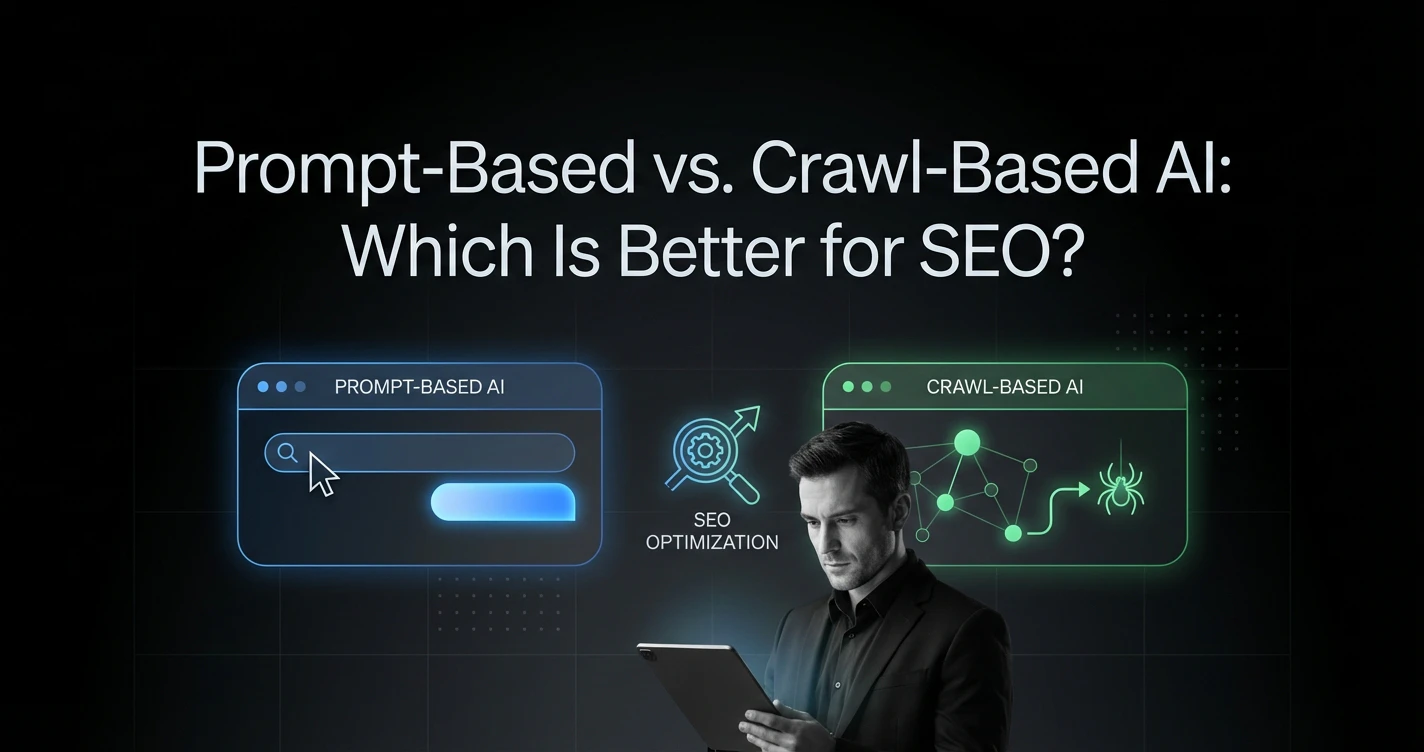
Want to go deeper? Explore our guides on building E-E-A-T signals, choosing between prompt-based and crawl-based AI for SEO, and preserving your brand voice with AI tools.
Conclusion: The Slop-Proof Blogger's Checklist
AI slop isn't going away. But it doesn't have to take you down with it. Here's what to remember:
- 52% of online content is AI-generated - and most of it gets filtered out before anyone sees it. Being in the other 48% (or the human-led part of the blend) is a competitive advantage.
- Human content earns 5.44x more traffic and gets cited by AI systems 82% of the time. The numbers are on your side.
- Readers are actively choosing human voices. Consumer preference for AI content dropped from 60% to 26% in three years.
- Google is enforcing quality. The "Lowest" rating for lazy AI content, the 45% reduction in unoriginal search results, the 80% traffic drops for offenders - the guardrails are tightening.
- Your advantage is your experience. Personal data, specific outcomes, honest opinions, and regular updates are things no AI prompt can replicate.
Start with one post. Lead with something only you know. Add one chart from your own data. Update it next month with what you've learned since. That's not a content strategy - it's a trust strategy. And in 2026, trust is the only currency that matters.
Ready to put this into practice? See how Rankenstein's AI blog writer combines live SERP research with E-E-A-T optimization to produce content that ranks - without the slop.