Why Your Brand Voice Gets Lost in AI Content (And How to Fix It)
94% of marketers use AI for content, yet consistent branding drives 23% more revenue (Lucidpress). Here's the research-backed framework to protect your voice.
TL;DR: 94% of marketers use AI for content, yet consistent branding drives 23% more revenue (Lucidpress). Build a brand voice system with tone profiles, reference examples, and AI guardrails to scale without losing your identity.
At a Glance
94% of marketers plan to use AI in content creation in 2026 (HubSpot, 1,500+ global marketers surveyed). Yet consistent branding drives a 23% average revenue increase (Lucidpress). Google's John Mueller called low-quality AI content "digital mulch" in August 2025. The gap between AI adoption and brand voice preservation is where most content strategies fail.
About the Author
Daniel Agrici is Co-Founder at Rankenstein, where he oversees product development and AI-assisted content strategy. With over eight years in technical SEO and content automation, Daniel has led content operations for B2B SaaS companies across fintech, healthtech, and enterprise software verticals. He writes about the intersection of AI tools and editorial quality.
Why Does AI Content Sound the Same?
19.56% of Google search results contained AI-generated content as of July 2025, dropping to 17.31% by September (Originality.ai, ongoing tracking study). Google's John Mueller called this flood of generic SEO content "digital mulch" (Search Engine Journal, August 2025).
AI models optimize for the highest-probability token at each step. This statistical approach produces text that regresses toward the internet's average style. When every competitor uses the same models with similar prompts, the output converges into indistinguishable content.

This homogeneity signals a lack of original expertise. It directly conflicts with Google's E-E-A-T requirements for niche authority. Mueller clarified in November 2025: "Our systems don't care if content is created by AI or humans. What matters is helpful" (Google).
The problem is not AI itself. The problem is treating AI as a writer instead of a tool that needs structured brand constraints to produce distinctive output. Brand voice preservation has to be designed into the broader AI content workflow, not bolted on after drafts are generated.
How Does Brand Inconsistency Affect Revenue?
Companies with consistent branding see a 23% average revenue increase, with 68% reporting 10-20% or more revenue contribution from brand consistency alone (Lucidpress State of Brand Consistency Report). McKinsey's personalization research found that leading companies generate 40% more revenue from personalization than average performers (McKinsey).

When AI-generated content strips away your brand's distinctive voice, the revenue impact compounds. Generic content performs identically to every competitor's generic content. There is no differentiation, no recognition, and no loyalty signal. Calculating the true ROI of AI content workflows must account for this brand erosion alongside time savings.

The scale of AI adoption makes brand voice preservation urgent. With 89% of marketers already using generative AI tools (HubSpot), the brands that maintain distinctive voices will capture disproportionate attention.
What Makes a Brand Voice System Work?
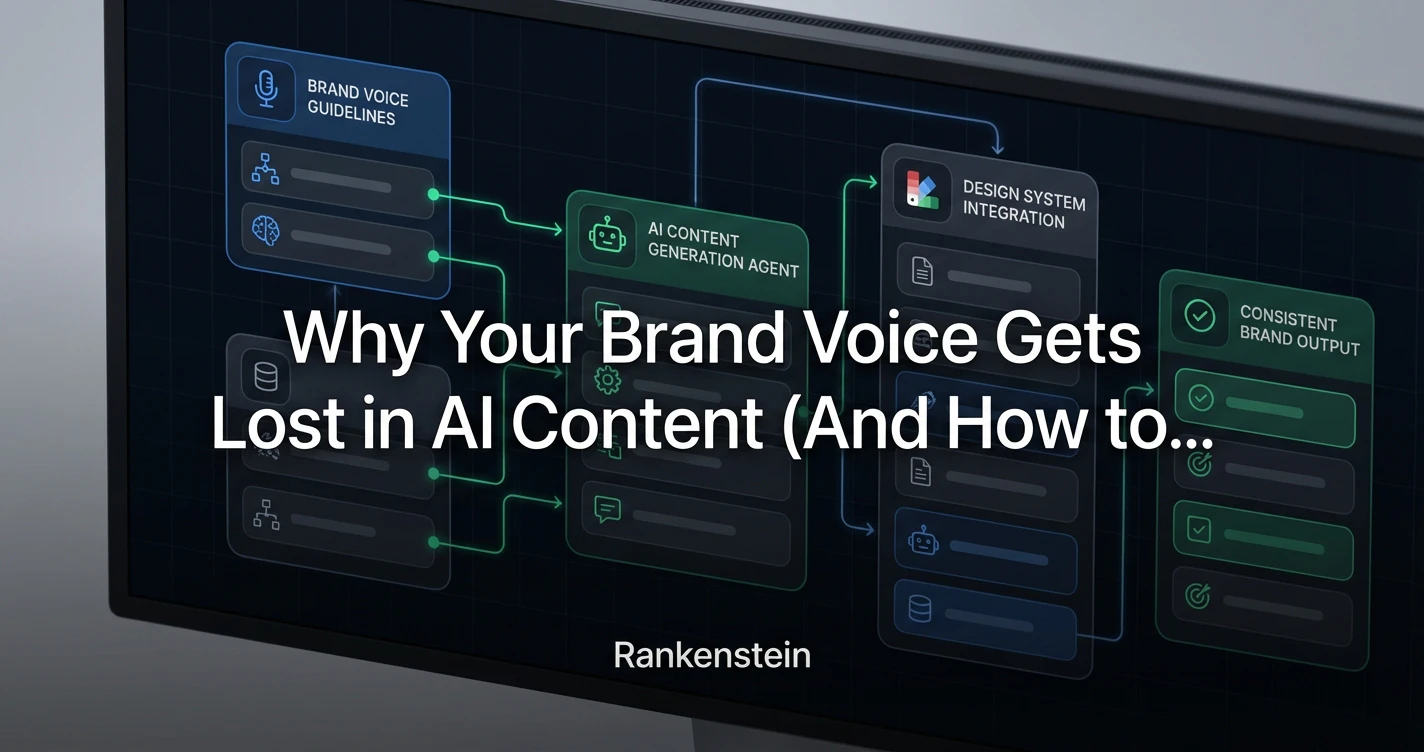
89% of marketers use generative AI for content tools, yet most rely on basic prompting without structured voice constraints (HubSpot). Modern brand systems must evolve beyond visual UI kits to include content modules that define rhythmic pacing, vocabulary constraints, and sentence length distributions.
To implement this, treat your brand voice as a set of modular components:
- Rhythm and Pacing Modules: Defined sentence length averages (e.g., "short, punchy, authoritative" = 12-word average sentences with max 20).
- Lexicon Modules: A database of "on-brand" versus "off-brand" terminology. Ban generic phrases. Require specific alternatives.
- Phonetic Modules: Rules for alliteration frequency, technical jargon density, and active-to-passive voice ratios (e.g., 80% active minimum).

These modules act as a programmatic "voice box." They ensure every piece of AI-generated content aligns with your established identity, regardless of which team member writes the prompt.
How Do You Train AI on Brand Guidelines?
John Mueller stated plainly: "Just rewriting AI content by a human won't change that, it won't make it authentic" (Google). Training generative AI effectively requires moving from descriptive prompts to structural constraints through few-shot learning and system-level instructions.
The most effective training involves feeding models structured JSON objects of brand attributes rather than long-form PDF guides. Structured constraints reduce "hallucination" of tone and ensure adherence to specific editorial standards.

| Training Element | Traditional Approach | Structured Approach |
|---|---|---|
| Voice Definition | Adjectives (e.g., "Bold") | Quantifiable ratios (e.g., 80% active voice) |
| Contextual Data | Static guidelines PDF | Live SERP data and internal link graphs |
| Quality Control | Manual review after publish | Automated sentiment monitoring pre-publish |
| Scale | One-off prompts per piece | Integrated design system modules |
Providing "negative constraints" (what the brand is NOT) often proves more effective than positive direction. Telling an AI "never use passive voice, never use jargon from this list, never exceed 15-word sentences" produces more consistent results than saying "be bold and direct."
What Role Does Business Intelligence Play in Brand Voice?
94% of European marketing organizations have not advanced their generative AI maturity beyond scattered initiatives (McKinsey, 2025). Business intelligence modules allow teams to monitor the phonetic and emotional performance of content at scale, identifying where AI-generated text diverges from intended brand sentiment.
Data-driven feedback loops are essential for maintaining brand integrity. These modules track metrics like "corporate jargon density" and "sentiment variance," providing a dashboard view of how well your content engine adheres to core brand identity.
Practical BI metrics to monitor include:
- Sentiment drift: How far each piece deviates from your target emotional tone.
- Vocabulary consistency: Percentage of on-brand terminology versus generic alternatives.
- Readability variance: Whether AI outputs maintain your target Flesch score range.
- Active voice ratio: Track whether the AI maintains your minimum active voice threshold.
Without automated monitoring, brand voice erosion happens gradually and invisibly. By the time someone notices, dozens of published pieces may have drifted from the established identity.
How Do You Scale Brand Voice Without Losing Authenticity?
Google's January 2026 Authenticity Update prioritizes Experience, the first E in E-E-A-T (Google Search Central). It extends the scrutiny Google first applied in the Helpful Content Update and its stance on AI writing. The update evaluates language patterns indicating firsthand experience, specificity markers like exact measurements, and visual evidence including original photos and screenshots.

Governance at the enterprise level requires a "human-in-the-loop" strategy focused on auditing structural outputs rather than micro-editing individual sentences. Build proprietary frameworks that AI populates. Protect the "soul" of the brand, its unique perspective and proprietary data.
Creating a centralized "source of truth" for brand logic allows multiple content managers to scale production. The focus shifts from controlling individual outputs to maintaining the system that produces them.

Content with statistics earns 40% higher AI citation rates (Onely). Content less than three months old is 3x more likely to be cited by AI systems (Digitaloft). These signals reward the brands that invest in structured, data-rich, regularly maintained content, and penalize the generic AI slop that undermines brand differentiation.
What Brand Signals Can AI Not Replicate?
80% of sources cited by AI search engines do not appear in Google's traditional top results (Ahrefs, 2025). This means AI systems are independently evaluating content quality, and they reward signals that generic AI output cannot produce.
While AI can replicate syntax, it cannot synthesize proprietary research, internal site data, and cross-channel business intelligence into a cohesive strategic narrative. The signals AI cannot fake include:
- Firsthand experience data: Original testing results, case study specifics, proprietary metrics.
- Unique brand perspective: How your company uniquely interprets industry events, based on your specific market position.
- Internal benchmarks: Performance data from your own campaigns, not industry averages.
- Customer interaction patterns: Insights from real conversations, support tickets, and user feedback.
These proprietary inputs are the structural skeleton that AI cannot invent. They transform generic AI output into a functional asset within a larger organic growth strategy.
Frequently Asked Questions
Why does my AI content sound robotic even after I give it my style guide?
AI models prioritize high-probability word combinations, making abstract instructions like "be professional" ineffective. Translate your style guide into specific Design System Modules that dictate sentence length, technical word density limits, active voice minimums (80%), and specific banned phrases.
How does the January 2026 Authenticity Update affect brand voice?
Google's January 2026 update prioritizes Experience signals, language patterns indicating firsthand knowledge, specific measurements, original media, and personal anecdotes. Content must demonstrate the author lived the facts. Stock photography and generic AI phrasing are identifiable.
What percentage of search results contain AI-generated content?
Originality.ai's ongoing tracking study found 19.56% of Google search results contained AI content in July 2025, dropping to 17.31% by September. Mueller called this flood "digital mulch" in August 2025.
Can AI learn to mimic a specific brand's writing style perfectly?
Partially. AI can replicate vocabulary and sentence patterns, but cannot reproduce firsthand experiences, proprietary data, or unique market insights. Supplementing AI with structured brand constraints and original research produces the best results.
How do I use business intelligence to monitor brand voice consistency?
Integrate NLP tools that scan published content for sentiment drift, vocabulary consistency, and readability variance. McKinsey found 94% of European marketing organizations have not advanced their gen AI maturity beyond scattered initiatives (McKinsey, 2025).
When Does Human Oversight Still Matter?
Google's Quality Rater Guidelines expanded YMYL (Your Money or Your Life) in September 2025 to include elections, civic institutions, and trust in society (Google Quality Rater Guidelines, Sept 2025). "Trust is the most important member of the E-E-A-T family because untrustworthy pages have low E-E-A-T no matter how Experienced, Expert, or Authoritative they may seem."
Despite advancements in AI governance, certain high-stakes content elements still require full human oversight. Investigative analysis, original opinion pieces, and technical strategies in regulated industries require critical thinking that AI cannot provide.
For brands in YMYL sectors, including healthcare, finance, legal, and insurance, the stakes of brand voice failure extend beyond revenue. Inaccurate or generic content in these verticals erodes user trust and risks regulatory consequences.
Human oversight should focus on three areas: validating factual claims against primary sources, injecting proprietary experience that AI lacks, and ensuring emotional tone matches the gravity of the subject matter.
From Generic Output to Brand Authority
The future of content is not in better prompting but in better systems. As organic CTR declined 61% with AI Overviews (Seer Interactive, 2025, 3,119 queries), the evolving search landscape rewards content with a distinct, data-backed voice.
Content without maintenance loses 50% of its citation performance within 12-18 months (Semrush, 2025). Building brand voice systems, not one-off prompts, is what transforms AI capability into lasting competitive advantage.