The Complete Guide to Keyword Cannibalization (And How to Avoid It)
Just 1 in 80 suspected cases actually need fixing (Ahrefs). Learn how to audit keyword cannibalization, consolidate overlap, and recover lost rankings.

TL;DR: Only 1 in 80 suspected keyword cannibalization cases actually need fixing (Ahrefs). Audit your pages systematically, consolidate where there's genuine overlap, and leave intentional multi-ranking pages alone.
About the Author
Benjamin Samar is Co-Founder and Technical Director at Rankenstein, where he leads SEO content architecture for B2B SaaS clients. He has managed over 100 site migrations and audited 15,000+ SERPs across US, EU, and APAC markets since 2019.
What Is Keyword Cannibalization and Why Does It Matter?
An Ahrefs study of suspected cannibalization cases found that only 1 in 80 keywords actually needed fixing. Keyword cannibalization occurs when multiple pages on a single website compete for the same search query, splitting authority and confusing search engines about which URL to prioritize.

The problem compounds in a zero-click search landscape. SparkToro / Datos analyzed 334 billion queries in 2025 and found that 58.5% of Google searches end without a click. When organic clicks represent only 29.4% of all searches, splitting that limited traffic between competing pages is costly.

Cannibalization forces your own pages to fight each other for an already-scarce slice of organic traffic. Instead of one strong page capturing all the link equity, you end up with multiple weak pages that none can break into the top results.
Does Keyword Cannibalization Hurt Rankings?
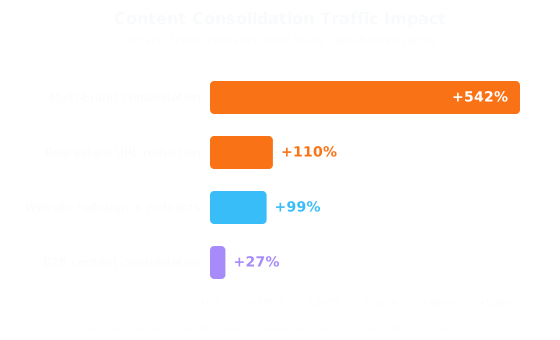
A Keyword Insights case study found that fixing cannibalization on a real estate website recovered 110% more organic traffic. The site reduced property type pages from 413 to 85, eliminating 15 million duplicate-intent URLs. This kind of strategic pruning directs all authority to the strongest pages.
Beyond rank fluctuations, cannibalization wastes crawl budget. When Googlebot indexes three competing versions of a "Keyword Research Guide," it has less capacity to discover new, high-priority pages. Your backlink equity also splits across multiple URLs instead of concentrating on one authoritative asset. Pages that consolidate authority through strong E-E-A-T signals consistently outperform scattered alternatives.
The top 3 Google results earn nearly 3x more clicks than position 3 alone (Semrush). Split authority across competing pages means none reach those top positions. Consolidation case studies consistently show traffic recoveries of 27% to 542%.
How Does Keyword Cannibalization Differ from Duplicate Content?
Keyword cannibalization is a strategic misalignment of search intent, whereas duplicate content means identical text blocks across different URLs. Two pages can have completely unique text and still cannibalize each other if they both target the same user intent for a keyword.
According to Ahrefs, the core difference lies in intent alignment. You can have two pages with no overlapping text that still compete because both target the "awareness" stage of the same keyword.
| Feature | Keyword Cannibalization | Duplicate Content |
|---|---|---|
| Primary Issue | Multiple URLs targeting the same intent | Identical text on multiple URLs |
| Search Engine Action | Fluctuating rankings (rank switching) | Filtering one version out of the index |
| User Experience | Confusing: which page is authoritative? | Redundant: seeing the same content twice |
| Primary Fix | Consolidation or intent re-alignment | Canonical tags or 301 redirects |
While duplicate content is often silently filtered by crawlers, cannibalized pages actively compete for the same ranking slot. Google's algorithms must choose between your own pages, often resulting in neither reaching its full potential.
How to Conduct a Keyword Cannibalization Audit
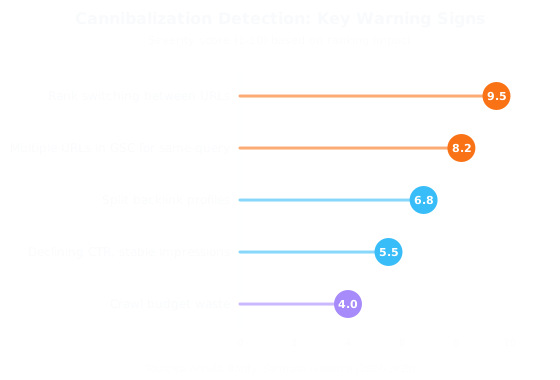
A Search Engine Journal analysis found that systematic auditing is the first step to recovery. The highest-severity warning sign is rank switching, where Google alternates which of your URLs appears for the same query. This indicates the algorithm cannot determine which page best serves the user's intent.

To conduct a professional-grade audit, follow these steps:
- Export Google Search Console data: Download your performance report. Filter for queries where multiple URLs receive impressions and clicks.
- Identify rank switching: Track whether Google frequently swaps which URL ranks for a specific term. This is the clearest cannibalization signal.
- Map intent to URL: Analyze the SERP for your target keyword. If results show how-to guides but you have a product page competing with a blog post, the blog post likely matches intent better.
- Analyze internal link distribution: Often the "wrong" page ranks because it receives more internal links than the optimized target page. A deliberate internal linking strategy ensures authority flows to the right URL.
How to Fix Keyword Cannibalization: 5 Proven Strategies
B2B companies that consolidated competing content saw 20% more ranking keywords, 27% more organic traffic, and 42% higher organic revenue (97th Floor / Moz). The key is choosing the right fix for each situation rather than applying a single solution to every case.

- Consolidate and redirect: Identify the strongest page by backlinks and conversions. Merge the unique value from weaker pages into it. Then 301 redirect the old URLs to the new master page.
- De-optimize the cannibal: If you must keep both pages, remove the target keyword from the title tag and H1 of the page that should not rank for that specific term.
- Canonicalize: Use the
rel="canonical"tag to tell search engines which URL is the master version. This is common in e-commerce for similar product variations where you need both pages live. - Re-align search intent: Rewrite one page to target a different funnel stage. Change one from "What is SEO" (informational) to "Best SEO Services" (commercial). Each page then serves a distinct purpose. Understanding how search intent drives modern SEO makes this re-alignment far more precise.
- Restructure internal links: Update internal links to point to the page you want to rank. Ensure anchor text is descriptive and consistently signals the correct target page.
As noted by Search Engine Land, fixing these issues is not about deleting content. It is about providing the most coherent path for both users and search engines.
Why Do Standard SEO Tools Often Miss Cannibalization?
Google's John Mueller confirmed that having multiple pages rank for the same keyword is "a strategic question rather than a pure SEO question" (Search Engine Journal, 2025). Standard tools flag keyword overlap but cannot distinguish between true cannibalization and legitimate multi-intent rankings. The distinction between prompt-based and crawl-based AI approaches matters here: tools that crawl your live site architecture detect real intent conflicts that static analysis misses.
The "intent paradox" occurs when a single keyword serves multiple user needs simultaneously. A search for "CRM software" might return both listicles and product homepages. If your brand has both and Google's SERP allows different intents, deleting one could hurt your total share of voice.
The critical test is whether your pages are "fighting" or "coexisting." According to Ahrefs, if one page rises while the other drops, that is true cannibalization. If both remain stable, they serve different sub-intents and should be left alone.
When Are Multiple Rankings Actually Better Than One?
The top 3 Google results earn nearly 3x more clicks than position 3 alone (Semrush). Brands dominating the first page with multiple distinct assets, a blog post, a YouTube video, and a tool, can capture more total traffic than a single result would.

If your pages satisfy different sub-intents, such as a how-to guide and a template download, Google may reward you with two ranking slots. This is not cannibalization. It is topical dominance.
The key distinction is stability. Monitor whether your pages hold steady positions or oscillate. Stable dual rankings mean Google recognizes each page serves a different need. Oscillating positions mean the algorithm is confused and you need to intervene.
Frequently Asked Questions
What is keyword cannibalization in SEO?
Keyword cannibalization occurs when multiple pages on the same website compete for the same search query and intent. This splits click-through rates, dilutes backlink equity, and wastes crawl budget. An Ahrefs study found that only 1 in 80 suspected cases actually needed fixing.
How do I find keyword cannibalization issues?
Export your Google Search Console performance report and filter for queries where multiple URLs receive impressions. The clearest signal is rank switching, where Google alternates which URL appears. Both Semrush and Ahrefs offer dedicated cannibalization detection tools.
Does keyword cannibalization always hurt my site?
Not always. Google's John Mueller confirmed that multiple pages ranking for the same keyword is a strategic question, not inherently harmful. When pages serve different sub-intents, both can rank stably. The problem only occurs when pages compete for identical intent.
How do I fix keyword cannibalization?
The five proven strategies are: consolidate competing pages into one power page, implement 301 redirects, add canonical tags, re-align search intent between pages, and restructure internal links. B2B companies using content consolidation saw 20% more ranking keywords and 42% higher organic revenue (97th Floor / Moz).
Building a Cannibal-Free Content Strategy
Successful SEO requires precise, research-first architecture that respects intent boundaries for every keyword. Identify overlap early by maintaining a content map before publishing. Search your own site for the target keyword to confirm you are not duplicating an existing intent.
By consolidating competing assets and re-aligning intent, you transform a fragmented website into a high-authority engine. The data is clear: case studies show traffic recoveries ranging from 27% to 542% after fixing cannibalization. A data-backed content workflow ensures every page strengthens the whole rather than consuming its neighbors.